
A comprehensive guide to evolving from the conditioned to the creator: a system for conscious women ready to design their own rhythm.
As far back as I can remember, I wanted to be free.
Not the version the world expected.
Not the version that followed a prescribed life timeline ,how I should live, who I should be, how I should dress, act, look, or decide “what to do.”
I’ve always been wired as an independent thinker.
An absolute individual.
I was the kid who questioned everything.
The young woman who challenged rules that didn’t make sense.
I wanted to understand why we live the way we do and how to do it differently.
That drive shaped everything that came after.
In my early 30s, I became obsessed with fitness.
In my later 30s, my focus expanded. I became fascinated with what it actually means to reach your highest potential, not in one area, but across the full spectrum of life: mind, body, spirit, and the work you bring into the world.
I didn’t want success in one lane while neglecting the others.
I wanted a complete system a life that worked in alignment, not opposition.
Over the past 12 years, I’ve studied deeply across fitness, nutrition, modern business, psychology, personal development, philosophy, and spirituality. Not casually. Intentionally. Looking for patterns. Testing ideas in real life. Keeping what worked and discarding what didn’t.
I built strength first, then awareness, then freedom. Each stage informed the next and none of them stood alone.
Fitness taught me discipline and respect for structure. Research showed me how habits quietly shape identity over time. Faith grounded me in something steadier than achievement. Creation gave me purpose and direction. Together, they revealed a pattern I couldn’t ignore.
You don’t evolve by force, and you don’t evolve by following the crowd. Real change happens by design.
This isn’t a plan or a checklist. It’s an operating system. It’s a conscious way of living that strengthens every dimension of you at once.
When I first began to see my life through this lens, I realized I wasn’t lacking discipline or motivation. I was living inside a system I never consciously chose. Once I saw that, I couldn’t unsee it.
What follows may challenge what you’ve been taught, and that’s intentional. Keep your mind open and your judgment low. Take what fits, question everything, and leave the rest. You don’t need philosophy you can’t apply. You need a map that makes evolution inevitable.
This is that map.
What I mean when I say freedom
Throughout this piece, I use the terms Human 1.0, 2.0, and 3.0. This isn’t abstract theory. It’s shorthand for developmental stages of awareness and agency. In the context of this work, I’m speaking directly to women, to how these stages show up in our bodies, identities, roles, rhythms, and choices.
So when I say Human, read woman in context. A woman shaped by conditioning. A woman reclaiming authorship. A woman creating from clarity.
When I talk about freedom, I’m not talking about rebellion, escape, or the absence of responsibility. I’m not talking about rejecting structure or doing whatever you want whenever you want. That version of freedom sounds appealing, but it collapses quickly.
The freedom I’m referring to is internal.
It’s freedom from living on autopilot. Freedom from borrowed beliefs, inherited scripts, and unexamined defaults that quietly shape how you think, choose, and move through the world. It’s the ability to pause, observe, and decide deliberately instead of reacting out of habit or expectation.
This kind of freedom is cognitive before it’s behavioral. It’s the ability to think for yourself, to understand why you believe what you believe, and to recognize when a choice is truly yours versus something you absorbed without question. It’s choosing your rhythm instead of inheriting one, and building structure that supports your life instead of trapping you inside it.
Real freedom doesn’t eliminate discipline, it depends on it. It doesn’t reject systems, it refines them. And it doesn’t remove responsibility, it places responsibility where it belongs: with you.
When you live with this kind of freedom, your choices are intentional rather than habitual. Your boundaries are clear instead of reactive. Your identity is rooted, not borrowed. Over time, your life stops looking like a series of obligations and starts reflecting authorship.
This is the freedom that sits at the top of the pyramid. Not chaos or escape, but agency over your own mind. And once you experience it, comfort stops masquerading as truth, and you stop living someone else’s version of a good life.
Why Human 2.0 Now
We’re living in a time where many people believe they’re free, yet most are still following a script written long before they were born. The structure is subtle, but it’s deeply ingrained.
From the moment we enter the school system, we’re trained to obey. We memorize, repeat, and comply. We learn how to fit in, not how to discover. We’re rewarded for staying inside the lines, not for questioning why those lines exist in the first place.
Eventually, that training turns into a socially approved checklist for adulthood: go to college, get the job, find someone respectable to marry, buy the house, have the kids, work for decades, retire quietly, and call it a good life. Because the path is familiar and widely accepted, we rarely stop to ask whether it’s actually aligned.
Tradition itself isn’t the problem. Many traditions carry wisdom. But much of what we now call tradition was designed to keep people predictable. It taught us to value comfort over curiosity, approval over authenticity, and safety over self-trust.
For modern women, this conditioning has intensified. We’re expected to be everything at once: caretaker, provider, nurturer, achiever, peacemaker. We’re praised for doing it all, even when doing it all is slowly draining our energy, clarity, and sense of self.
This isn’t a personal failure or a lack of resilience. It’s a system that rewards endurance over alignment.
Human 2.0 exists because the old operating system no longer supports wholeness. It was never designed to.
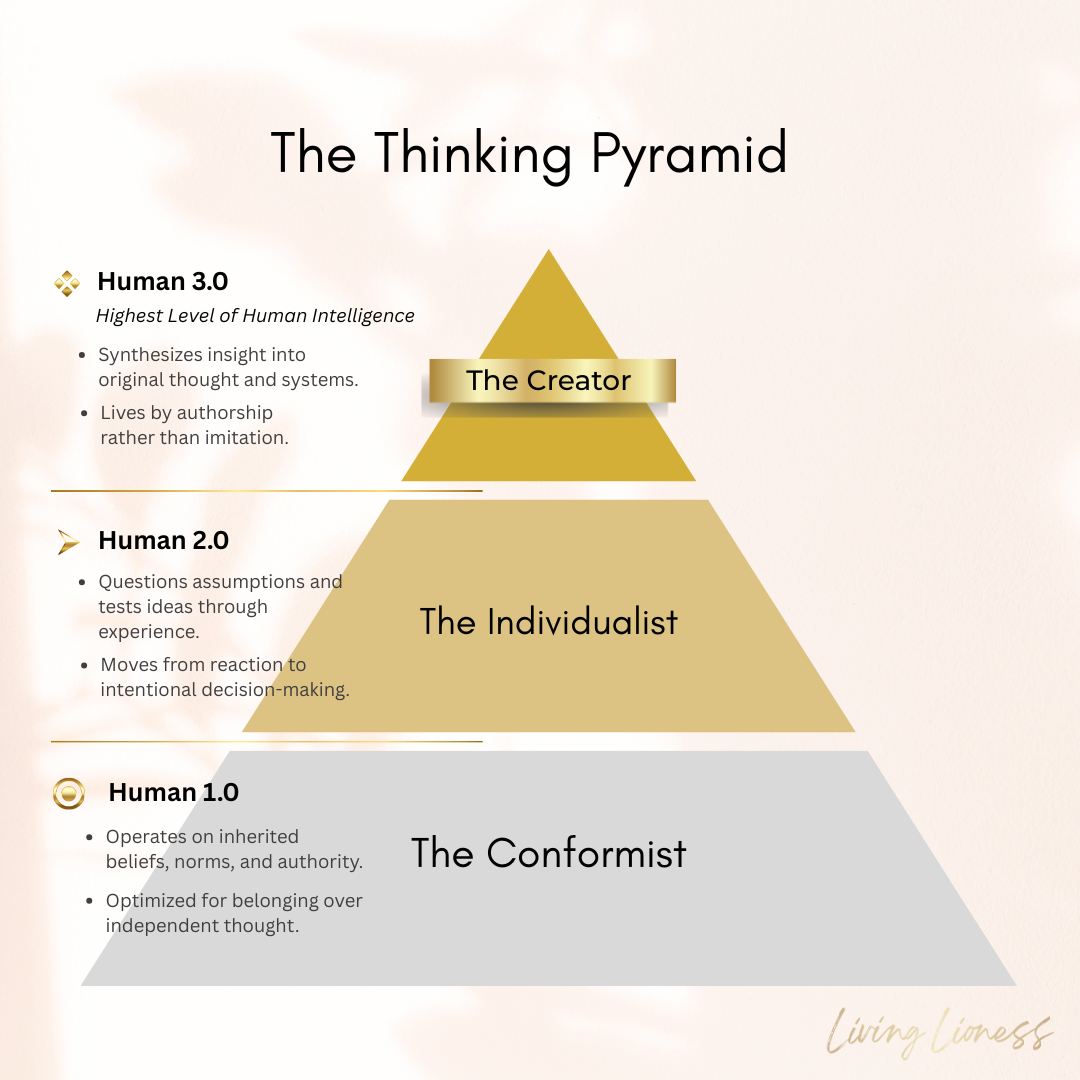
Note: This model is informed by Bloom’s Taxonomy of Cognitive Domains and later developments in cognitive science, which describe a progression from basic recall and repetition to higher-order thinking, synthesis, and creation.
What each level of the pyramid actually represents
Human 1.0 — The Conformist
This level is shaped by inherited authority. Beliefs, goals, and values are absorbed rather than examined. Thinking tends to be linear and binary, with a strong sense that there is one “right” way to live, work, or succeed.
Most people don’t choose this level. They inherit it.
At Human 1.0, safety comes from fitting in. Repetition feels responsible. Questioning feels risky. Identity is built through roles, expectations, and external approval.
Human 2.0 — The Individualist
This is where separation begins.
Human 2.0 starts questioning what was handed down and begins choosing a self-defined path. Standards form internally. Boundaries sharpen. Personal agency increases.
At this stage, thinking is more independent but can still be rigid. There’s often attachment to “my way,” because it’s the first time choices are truly one’s own. This phase is necessary. It’s where discernment and self-leadership are built.
Human 3.0 — The Creator
At the highest level, thinking becomes integrative.
Human 3.0 can hold multiple perspectives without collapsing into certainty. She recognizes partial truths, synthesizes them, and builds better systems, decisions, and solutions.
This is where creativity lives. Not as expression, but as design and authorship.
What may look like selectiveness at this level isn’t narrow-mindedness. It’s intentional filtering. Noise is removed so clarity can remain.
Human 3.0 doesn’t react to the world. She builds within it.
The Thinking Pyramid: Why Most People Never Leave the Bottom
Most of society is operating at the lowest level of thinking.
Not because people are unintelligent, but because modern life rewards speed, reaction, and repetition.
Here’s the illusion: collecting information is mistaken for thinking.
It isn’t.
Knowledge is something you receive.
Thinking is something you do.
At the bottom of the pyramid, people repeat what they’ve heard, defend what feels familiar, and treat all knowledge as equal whether it’s useful or meaningless, tested or untested.
This creates a dangerous confidence without clarity.
People feel informed, but not free.
How to locate yourself on the pyramid
Read this as a mirror, not a judgment.
You are likely at the bottom if:
-
- you make decisions because “this is what people say works”
-
- you struggle to explain why you believe what you believe
-
- you repeat advice you’ve never tested
-
- you become defensive when your views are questioned
-
- you confuse familiarity with truth
You are climbing if:
-
- you slow decisions down
-
- you can sit with uncertainty
-
- you notice contradictions without panic
-
- you ask where a belief came from before obeying it
You are near the top if:
-
- you synthesize ideas into your own frameworks
-
- you can change your mind without losing your sense of self
-
- you live by standards shaped through experience, not trends
-
- you create something new: a model, a solution, a way of living that actually works
Real thinking feels uncomfortable.
That’s why most people stop.
A deeper sign you’re at the bottom: borrowed identity
One of the clearest signs of living at the bottom of the pyramid isn’t ignorance.
It’s the absence of independent identity.
At this level, thinking hasn’t just been outsourced — selfhood has too. You don’t truly know yourself, because you’ve never been required to. Your preferences, routines, goals, and even your sense of “who you are” have been shaped almost entirely by what society handed you.
You followed the path.
You checked the boxes.
You adopted the lifestyle that was presented as normal, responsible, or successful.
And because it all looked acceptable from the outside, you never stopped to ask whether it was true for you.
This is what conditioning actually looks like.
Not control through force — but control through templates.
Signs of a borrowed identity
Again, awareness- not accusation.
-
- You struggle to name interests that aren’t tied to productivity, appearance, or approval.
-
- When asked what excites you, your answers sound generic.
-
- You confuse roles with identity: wife, mother, employee, caretaker.
-
- Your life makes sense on paper, but feels hollow.
-
- Stillness feels uncomfortable because it exposes how little you’ve explored who you are without expectation.
At the deepest level, the bottom of the pyramid isn’t just about repeating information.
It’s about repeating lives.
Lives inherited instead of designed.
Beliefs absorbed instead of examined.
Desires conditioned instead of chosen.
And the most dangerous part?
This feels normal.
Because when everyone around you is doing the same thing, conditioning disguises itself as belonging.
What the lowest level actually looks like in real life
One of the clearest real-world signs of being at the bottom of the pyramid is this:
People don’t think, they repeat.
You’ve seen it.
Someone repeats a headline they heard on the news.
Or a talking point from a podcast.
Or a viral opinion from social media.
Same phrasing.
Same emotional tone.
Same certainty.
There’s no pause. No curiosity. No integration.
There’s no analysis, no questioning, no synthesis. Just a clean handoff of information from one source to another – like a relay race of opinions.
You can feel it when you’re talking to them.
You’re not having a conversation. You’re listening to a script.
If you ask, “Why do you believe that?” they don’t reflect, they defend. Or worse, they can’t explain why they think what they think.
If you ask, “Where did that idea come from?” the answer always points outward.
If you introduce nuance, curiosity shuts down.
That’s not confidence. That’s conditioning.
And once you see it, you can’t unsee it.
Why this happens (and why it feels unsettling)
At the lowest level of the pyramid, the brain is optimized for speed and belonging, not depth.
Repeating ideas feels safe.
Agreeing feels rewarding.
Standing out feels risky.
So the mind shortcuts thinking and adopts certainty from “authority”- media, influencers, institutions, or group identity. It’s faster, socially safer, and requires far less energy than independent thought.
This is why conversations feel flat.
This is why debates go nowhere.
This is why people argue without listening.
There is no internal processing happening. Just stimulus → reaction → repetition.
It isn’t malicious. It’s automatic.
And this is also why the pattern feels unsettling once you notice it. When you stop outsourcing your thinking, the contrast becomes obvious. You feel the gap between presence and performance, between engagement and scripting.
More than that, you start to feel the cost.
Because when you never form your own thoughts, you never form a strong sense of self.
The subtle cost of regurgitation
Living this way doesn’t just limit thinking. It limits identity.
When someone only repeats what they’ve heard, their beliefs aren’t rooted in experience. Their opinions collapse under pressure. Their sense of self depends on external validation. Their life choices begin to mirror whatever is socially reinforced around them.
This is how people wake up decades into lives they never consciously chose.
Not because they were lazy.
Not because they lacked intelligence.
But because they were never taught to pause and think.
Over time, the cost compounds. Decisions feel heavier. Direction feels unclear. Fulfillment stays just out of reach. Life becomes something to manage instead of something to author.
And the most disorienting part is this: from the outside, everything can look fine.
Which is why so many people stay here.
The shift that moves you up the pyramid
Climbing out of the bottom of the pyramid doesn’t require intelligence.
It requires interruption.
The moment you stop repeating and start asking:
-
- “Does this actually make sense?”
-
- “Do I believe this ,or did I inherit it?”
-
- “How does this apply to my life, my values, my experience?”
-
- “What do I think after sitting with this?”
That pause is powerful.
It’s the moment thinking becomes yours.
Human 2.0 begins right there, not with answers, but with ownership of your mind.
You don’t need certainty to move up the pyramid. You need willingness. Willingness to sit with discomfort instead of rushing to resolve it. Willingness to slow down when speed is rewarded. Willingness to be wrong without collapsing your sense of self.
This is where independence actually forms.
What most people don’t realize
Independent thinking doesn’t draw attention to itself.
It doesn’t argue loudly. It doesn’t try to win conversations. It doesn’t repeat slogans or talking points. Most of the time, it isn’t even visible from the outside.
What it does instead is integrate.
It slows decisions down. It asks better questions. It considers context, consequence, and experience before reacting. It’s less concerned with being heard and more concerned with being accurate.
This is why developing independent thought can feel strange at first. You’re no longer rewarded with immediate agreement. You’re no longer reinforced by sameness. Conversations change, not because you’re superior, but because you’re no longer operating on autopilot.
You start noticing who is actually present in a conversation and who is simply reciting. Who is thinking and who is defending. Who is open and who is protecting certainty.
Not with judgment.
With clarity.
And once that clarity forms, it doesn’t go away.
What the transition from Human 1.0 to Human 2.0 actually feels like
The shift into Human 2.0 rarely happens in a dramatic moment. It usually begins quietly, almost uncomfortably, when something familiar stops working.
You might still be doing all the “right” things. Your life may look fine from the outside. But internally, there’s friction. Conversations feel repetitive. Advice feels hollow. Routines that once felt stabilizing now feel constricting. You start noticing how often people speak without thinking, repeat without questioning, react without awareness.
And then you notice something else.
You can’t participate in it the same way anymore.
This is often the first real sign of Human 2.0 coming online: you can no longer unsee the pattern.
This was the point where my own thinking changed, not overnight, but permanently.
A real-world contrast you’ll recognize
You’re in a conversation. Someone repeats a headline they heard on the news or a talking point they absorbed from social media. The words come out confidently, but they aren’t integrated. There’s no pause, no curiosity, no ownership of the thought.
When you ask a simple question: “Well, why do you think that?” the energy shifts. Defensiveness appears. The conversation doesn’t deepen; it hardens.
At Human 1.0, this feels normal.
At Human 2.0, it feels disorienting.
Not because you think you’re smarter, but because you’ve started processing information differently. You’re no longer collecting opinions to belong. You’re filtering ideas through experience, values, and consequence.
You’re not interested in being right.
You’re interested in being accurate.
That distinction changes everything.
Why this stage can feel lonely at first
You stop filling space just to feel connected. You stop adopting opinions for social safety. You listen more carefully, speak more deliberately, and when a conversation isn’t going anywhere, you’re comfortable letting it end. Sometimes that means changing the subject. Sometimes it means physically walking away instead of forcing engagement that doesn’t add value.
This can feel isolating at first if you don’t understand what’s happening. Many women mistake this phase for disconnection, when it’s actually discernment developing. You’re learning to tolerate not knowing, not agreeing, and not being immediately mirrored back.
That tolerance is strength. It’s the foundation of independent thought.
It’s the foundation of independent thought.
What “walking away” actually looks like in practice
It’s not dramatic. There’s no confrontation or announcement.
It might look like you nodding, realizing the conversation has hit a ceiling, and saying, “Interesting,” without needing to push it further. You don’t debate. You don’t correct. You don’t perform intelligence for approval.
It might look like you excusing yourself to refresh a drink, step outside, or rejoin another group- not out of arrogance, but because you can feel the difference between a conversation that expands you and one that simply repeats noise.
Sometimes it’s internal. You stay physically present, but you stop investing energy. You listen without absorbing. You let the words pass through instead of attaching to them.
What’s different at Human 2.0 is that you no longer confuse engagement with obligation. You don’t owe your attention to every opinion, story, or assumption placed in front of you. You choose where your energy goes, because you understand that attention is finite — and once spent, it doesn’t come back.
This isn’t withdrawal. It’s discernment in action.
Why most people stay at the bottom of the pyramid
Most people never walk away from these moments.
They stay in conversations that go nowhere. They absorb opinions without questioning them. They repeat what they’ve heard because it feels safer than pausing to think. Over time, that habit compounds.
At the bottom of the pyramid, thinking is reactive. Information comes in and goes right back out, unchanged. Headlines are repeated. Talking points are recycled. Opinions are borrowed, not examined. There’s no synthesis, no pause, no ownership of thought.
This isn’t because people are unintelligent. It’s because the system rewards speed, certainty, and agreement far more than it rewards depth. Thinking takes effort. Independent thought requires friction. And most environments are designed to remove friction, not encourage it.
So people stay plugged in. They scroll. They watch. They listen. They repeat. They rarely stop long enough to ask, “Do I actually believe this?” or “Does this make sense in my own lived experience?”
That’s why walking away from shallow conversations matters more than it seems. It’s not about superiority or disengagement. It’s about interrupting the automatic loop of consumption and regurgitation that keeps the mind parked at the lowest level of thinking.
When you stop giving your attention to everything placed in front of you, you create space. And space is where thinking begins.
That pause- the one where you don’t immediately respond, repeat, or react, is the first step up the pyramid. It’s the moment you stop being a container for other people’s ideas and start becoming a processor of your own.
Most people never take that step, not because they can’t, but because they’ve never been taught that it’s an option.
The science behind shallow thinking
The brain adapts to how it’s used. This isn’t philosophy, it’s neuroscience.
Neuroplasticity means your brain is constantly rewiring itself based on what you repeatedly consume, focus on, and practice. Attention isn’t passive. Whatever you give it to, your brain builds more capacity for that mode of thinking.
When your days are dominated by passive consumption- scrolling, binge-watching, constant notifications, background noise ,your brain adapts accordingly. It becomes efficient at fast intake, emotional reaction, and surface-level pattern recognition. What it does not build is depth, synthesis, or sustained reasoning.
Research shows that heavy media multitasking reduces working memory capacity, weakens attention control, and increases susceptibility to distraction. In simple terms, the more fragmented your attention becomes, the harder it is to hold complex ideas, question assumptions, or think independently.
This is why most people feel mentally busy but cognitively shallow. They’re overloaded with information but undertrained in processing it.
Another layer most people don’t realize: decision quality degrades as the day goes on. Cognitive fatigue is real. Studies in behavioral psychology and neuroscience show that humans make more errors, rely more on shortcuts, and default to familiar thinking patterns later in the day. This is why reaction replaces reasoning when energy drops.
There’s real-world data that proves this isn’t just theory. In the medical field, where accuracy is literally a matter of life and death, studies have shown that errors and delays increase later in the day compared to morning hours. One large-scale analysis of hospital adverse events found that patient harm was significantly more likely to occur in the afternoon and evening, when cognitive fatigue, circadian dips, and system handoffs compound decision strain. You can read the study here:
Time of day effects on medical errors – National Institutes of Health
This matters because it confirms something most people feel but rarely question: the brain does not think equally well all day long. As mental energy declines, humans rely more on shortcuts, habit, and reaction instead of deliberate thought.
It’s also why comfort behaviors dominate at night. Streaming shows, endless scrolling, late-night snacking – none of these are moral failures. They’re predictable responses from a tired nervous system seeking relief. But when this becomes the default, the brain is trained to avoid effort, not engage it.
Over time, this keeps cognition parked at the lowest levels of the pyramid.
Not because people lack intelligence, but because their environment constantly reinforces consumption over creation.
Deep thinking requires quiet, energy, and space. Those conditions don’t happen accidentally. They have to be protected.
This is one reason I structure my life the way I do.
I go to bed early. Often earlier than what’s considered “normal” – (or should we say, “average”). I wake up before most people are online, before the noise starts. My brain is sharp, rested, and clear. The science backs this: the brain’s capacity for strategy, synthesis, and long-range thinking is strongest earlier in the day, before decision fatigue sets in.
I routinely get more meaningful work done before 8 a.m. than many people do in two days- not because I’m special, but because I’ve designed my rhythm to support higher-order thinking instead of numbing it.
This doesn’t mean everyone needs my schedule. It does mean that depth requires intention.
Night owls will argue their case, and that’s fine. The point isn’t the hour on the clock- it’s whether your best thinking happens when your brain has energy, quiet, and space. Most people never test this because they never give themselves the conditions to find out.
And this is where “entertainment” fits in.
There’s nothing wrong with watching a good show. I enjoy them too. But I’m selective. Very selective. Not because I’m rigid or trying to prove something, but because attention is finite. What you repeatedly consume becomes mental structure.
Stories shape perception. Narratives wire expectations. Emotional pacing trains your nervous system. When entertainment becomes constant, it doesn’t just fill time- it fills your inner landscape.
I get recommendations all the time. Most of them I decline, without explanation. Not because I’m dismissive, but because I’m intentional. I don’t want my mind trained for distraction, outrage, or passive absorption. I want it trained for clarity, pattern recognition, and creation.
This is the difference between consumption and consciousness.
Small doses of entertainment don’t harm cognition. Habitual overconsumption does. Not overnight- gradually, quietly, through repetition.
And that’s why most people stay at the bottom of the pyramid. Their attention is continuously rented out, their energy depleted, and their thinking outsourced to whatever happens to be loudest.
Rising isn’t about rejecting modern life. It’s about reclaiming your mind inside it.
The moment you become selective with your attention -conversations, media, schedules, inputs, you begin retraining your brain for depth. That’s not self-improvement. That’s self-leadership.
And it’s the gateway to everything that comes next.
Creativity & the emergence of Human 3.0 (Woman By Design)
Creativity is widely misunderstood.
Most people think it means being artistic, expressive, or aesthetic. Painting. Writing. Music. Design. That definition is incomplete. Creativity isn’t about style. It’s about synthesis.
At the highest level of thinking, creativity is the ability to take what you know, what you’ve lived, what you’ve analyzed, and what you’ve questioned, and produce something that didn’t exist before. A new solution. A new model. A clearer explanation. A reframing that changes how a problem is understood.
This is why creativity sits at the top of the pyramid. Not because it’s decorative, but because it requires everything beneath it to be developed first.
Biologically, creativity depends on integration. Multiple regions of the brain must work together: memory, reasoning, emotional regulation, and executive control. This kind of thinking doesn’t happen when attention is fragmented, energy is depleted, or the nervous system is overstimulated. It requires capacity.
Behaviorally, creativity only emerges when a person has moved beyond reaction. You can’t create while constantly responding. You can’t synthesize while endlessly consuming. And you can’t generate original thought if your mind is busy repeating what it last absorbed.
This is why most people never reach this level. Not because they lack intelligence, but because their lives are designed for intake, not output. Their attention is constantly occupied. Their thinking is reactive. Their energy is spent managing noise.
At the bottom of the pyramid, people remember and repeat. In the middle, they analyze and apply. At the top, they create.
Creation is where agency returns.
At this level, ideas no longer control you. You’re no longer governed by inherited beliefs, cultural scripts, or borrowed opinions. You can examine a pattern, keep what works, discard what doesn’t, and build something better in its place.
This is freedom in its truest sense. Not freedom from responsibility, but freedom from unconscious influence.
And this is where Human 3.0 begins.
Human 3.0 is not louder than Human 2.0. She doesn’t need to prove insight or perform intelligence. The work has already been done beneath the surface. Her structure is stable. Her attention is protected. Her nervous system is no longer running the show.
Human 2.0 was the phase of stabilization. Boundaries. Rhythm. Standards. Internal order.
Human 3.0 is what emerges once that order is embodied.
She no longer asks, “What should I think?” She asks, “What do I see?”
She no longer chases certainty. She tolerates complexity.
She no longer seeks consensus. She trusts her discernment.
Her work changes. Her relationships change. Her schedule changes. She protects her mornings because that’s when her mind is clearest. She becomes selective about what she watches, reads, and listens to, because she understands that input becomes structure.
And when conversations feel performative, inauthentic, or repetitive, she’s comfortable letting them end. Once you see those patterns, you can’t unsee them, and walking away becomes less about judgment and more about clarity.
Creativity is no longer something she does on the side. It becomes how she lives.
It shows up in how she solves problems. How she designs her days. How she builds systems that actually work for her life instead of fighting against it. Her decisions are no longer reactions to pressure; they’re expressions of alignment.
This is why creativity threatens systems built on compliance. A person who can think independently is harder to predict, harder to manipulate, and harder to control. Schools don’t train this. Most workplaces don’t reward it. Media doesn’t encourage it.
But your biology supports it, if you give it the conditions.
When your mind is rested, your attention protected, and your thinking practiced, creativity isn’t rare. It’s inevitable.
Human 3.0 doesn’t reject structure. She uses it.
Human 2.0 built the foundation.
Human 3.0 builds with it.
Not art for art’s sake, but a life that actually works.
Creation isn’t rebellion against the system. It’s transcendence of it.
And once you experience this level of thinking, you can’t unsee the difference. You recognize when thoughts are borrowed. You sense when conversations are shallow. You feel when your energy is being pulled away from what matters.
At this level, intelligence is no longer measured by how much you know. It’s measured by what you can build with what you know.
This is the shift from managing life to authoring it.
This is Human 3.0- The Creator.
What this leaves you with
At some point, awareness becomes responsibility.
Once you see how thinking actually works, how attention shapes identity, and how creativity emerges from structure, you can’t unknow it. You start noticing where your energy goes. You catch yourself repeating things you never examined. You feel the difference between engagement and distraction.
This isn’t meant to create pressure. It’s meant to create choice.
I didn’t change my life by learning more. I changed it by thinking differently.
Human 1.0 lives by inheritance.
Human 2.0 lives by intention.
Human 3.0 lives by creation.
None of these stages are wrong. They’re sequential. Each one serves a purpose. The issue isn’t where you are. It’s staying there unconsciously.
You don’t rise by rejecting the world you live in. You rise by learning how to think inside it without being absorbed by it. By choosing rhythm over reaction. Depth over noise. Authorship over imitation.
This is what freedom actually looks like. Not doing whatever you want, but knowing why you choose what you choose.
That’s the real upgrade.
Why this matters before Human 3.0
Human 3.0 cannot be forced.
Creation only emerges after clarity. Expression follows integration. When Human 2.0 is skipped, creativity becomes performative instead of grounded.
Human 2.0 is where the nervous system stabilizes, the mind sharpens, and identity roots internally. Without this phase, creation collapses into consumption dressed up as productivity.
That’s why this stage matters.
It’s not flashy.
It’s foundational.
How to begin moving up the pyramid from where you are
You don’t move up the pyramid by trying to become Human 3.0.
You move up by interrupting Human 1.0 patterns.
This isn’t about doing more. It’s about becoming deliberate.
1. Interrupt repetition
The next time you feel the urge to repeat an opinion, recommendation, or belief, pause and ask:
Do I actually know this, or did I inherit it?
That pause is thinking. It’s the first step out of autopilot.
2. Protect one daily pocket of clarity
Identify the part of your day when your mind feels most capable. Guard it. No scrolling. No background noise. Use it to think, write, walk, or reflect. Depth requires space, and space must be protected.
3. Reduce consumption before adding effort
You don’t need more discipline. You need fewer distractions. Remove one habitual input that fragments your attention. Don’t replace it with productivity. Replace it with stillness.
4. Upgrade questions before seeking answers
Instead of asking, “What should I do?” ask, “What actually makes sense for me?”
Instead of asking, “What do people say works?” ask, “What have I tested myself?”
Better questions sharpen thinking faster than better advice.
5. Let some conversations end
Not every exchange deserves your attention. When dialogue becomes repetitive or performative, let it conclude. This isn’t disengagement. It’s discernment. Attention is finite, and what you protect is what grows.
These aren’t dramatic shifts.
They’re structural ones.
This is how Human 2.0 is built.
Deliberately. Internally. Over time.
